Treble clef notes: lines, spaces and landmarks
Every line and space, the four landmarks that make it fast, and the ledger notes just above and below.
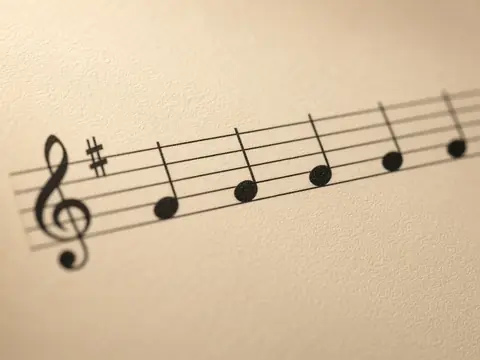
Key points
- Lines E G B D F; spaces F A C E.
- Landmarks: middle C, G4 (2nd line), C5 (3rd space), G5.
- Read from the nearest landmark, not from the bottom line.
The treble clef is the one most people learn first. Here are its notes, the four landmarks that make reading fast, and how to read the ledger notes just above and below.
Lines and spaces
| Bottom to top | Memory aid | |
|---|---|---|
| Lines | E4 · G4 · B4 · D5 · F5 | "Every Good Boy Does Fine" |
| Spaces | F4 · A4 · C5 · E5 | Spells "FACE" |
Four landmarks
- G4, the 2nd line: the treble clef's curl wraps around it. That is why it is the G clef.
- Middle C (C4): one ledger line below the staff.
- C5, the 3rd space: an octave above middle C.
- G5: the space just above the top line.
Just outside the staff
| Position | Note |
|---|---|
| Space below the bottom line | D4 |
| 1 ledger line below | C4 (middle C) |
| Below that ledger line | B3 |
| Space above the top line | G5 |
| 1 ledger line above | A5 |
| 2 ledger lines above | C6 |
More in reading ledger lines.
Stop counting from the bottom
If you find yourself reciting "Every Good Boy…" to name a note on the 4th line, you are reading the slow way. Instead, find the nearest landmark and count the step or skip: the 4th line is a third above B, or a third below the F at the top. Practise until the landmark is instant, then the neighbours follow.
Practice
- Use the note quiz on treble, staff only, until you average under two seconds a note; then add ledger lines.
- Read the melody line of hymn tunes and folk songs: lots of steps, a few skips.
- Say note names out loud while you play a slow scale from middle C to C6 and back.